The Operator Stack: Eight Disciplines, One P&L

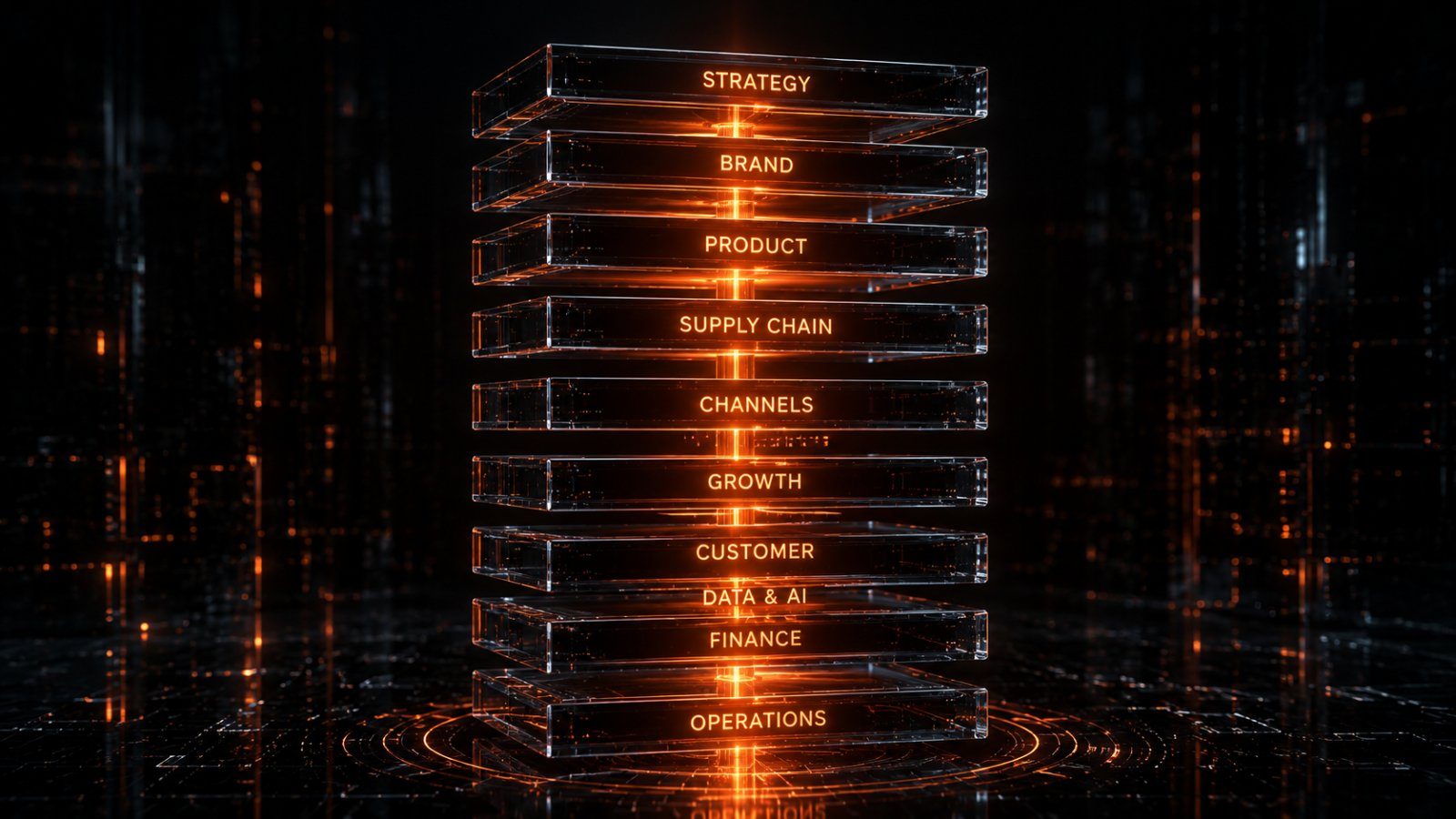
Ask a struggling brand who runs their growth marketing and you'll hear an agency's name. Ask who built their site — a different agency. Finance? An outsourced bookkeeper who emails quarterly. Each vendor optimizes its own invoice-able metric, nobody owns the interaction effects, and the P&L dies precisely in those gaps — where CAC meets margin, where site speed meets conversion, where inventory meets cash. Our structural bet is the opposite: every discipline that touches the P&L lives in-house, on one team, looking at one number.
- Growth marketing — paid acquisition as an engineering practice: testing velocity, attribution honesty, CAC discipline.
- Development — we build our own software; site speed, checkout, and integrations are product work, not vendor tickets.
- AI & data — the operating layer running repeatable decisions across every brand, continuously.
- Finance — real-time contribution margin by SKU and channel; cash conversion as a managed system.
- Consumer behavior — research and cohort psychology driving product and offer decisions, not opinions.
- Sales — wholesale, retail, and partnership channels opened deliberately, not accidentally.
- Operations — supply chain, fulfillment, and returns run on telemetry.
- Brand — positioning and creative that compound trust instead of renting attention.
Why integration beats excellence
A counterintuitive claim from watching hundreds of brands: integrated-good beats fragmented-great. An A-grade agency optimizing ROAS will happily scale spend into SKUs with broken contribution margins — it can't see landed costs. A brilliant 3PL hits ship-time SLAs while packaging costs quietly destroy the basket economics — it never sees the P&L. Every handoff between specialists is a place where the unit math falls on the floor. When the growth marketer, the finance lead, and the ops lead share a dashboard and a bonus pool, the interaction effects — where all the money actually is — finally have an owner.
The compounding trick: one stack, many brands
The standalone $3M brand can't afford this team — eight senior disciplines on one P&L is structurally impossible at that size, which is why brands outsource and why outsourcing caps them. The portfolio changes the arithmetic: build the stack once, amortize it across every brand, and let each discipline's learnings compound system-wide. The creative angle that wins for one brand seeds tests for three others. The supplier negotiation playbook transfers. The forecasting model gets smarter on every brand's data. This is the entire economic logic of our model — profit-first sequencing decides when to scale; the operator stack is how scaling stays profitable.
| Discipline | Fragmented (typical) | Integrated (ours) |
|---|---|---|
| Growth | Agency optimizes ROAS | In-house optimizes contribution margin per order |
| Development | Theme + plugin soup | Owned codebase, conversion as product work |
| AI/Data | Tool subscriptions, unused | Operating layer with decisions wired in |
| Finance | Quarterly bookkeeping | Live CM by SKU/channel; weekly cash discipline |
| Consumer behavior | Founder intuition | Cohort research feeding product/offer roadmap |
| Sales | Inbound luck | Deliberate wholesale/retail channel building |
What this looks like in week one of an acquisition
The stack is why our 90-day playbook works: the brand we acquire plugs into finance telemetry in days, inherits tested creative infrastructure in weeks, and gets channel development most founders could never staff. Nothing about it is magic — it's the same eight jobs every brand needs, done by people who share one P&L and have done it before, repeatedly, together. Validation tells us what deserves scale. The stack is what makes scale survivable.
Brands don't fail from lacking specialists. They fail in the handoffs between them. Kill the handoffs.
- We don't outsource P&L-touching disciplines — vendor margins and visibility gaps are the same line item.
- Acquired brands inherit the full stack from day one; that inheritance IS the value-creation plan.
- We hire operators who've owned outcomes across multiple disciplines — translators, not silo specialists.
Companions: Profit First, Scale Second, AI Is an Operating Model, Owned Audience Economics. Thesis content — how we actually run the portfolio.
Own a brand this applies to?
We talk to founders at every stage — long before they're ready to sell.
Start a Conversation →